Aquatec Reverse Osmosis Pumps
Questions?
Call us at (888) 382-3814

There are two types of electric pumps frequently used on Reverse Osmosis systems:
-
Booster Pumps are designed to increase water pressure to an ideal level as it enters your reverse osmosis unit.
-
Demand or Delivery Pumps are sometimes needed to move water from a storage tank to an application — for example, to feed pressurized water to a refrigerator, ice maker or a sink faucet. See below.
Booster Pumps
Aquatec 6800 and 8800 booster pumps are very similar in appearance and in performance. Knowing the gallon per day output of your reverse osmosis membrane will help you decide which pump to use:
-
If your RO unit is designed to produce less than 50 gallons per day, choose the 6800.
-
If your unit produces between 50 and 100 gallons per day, choose the 8800.
Aquatec 6800 Booster Pump
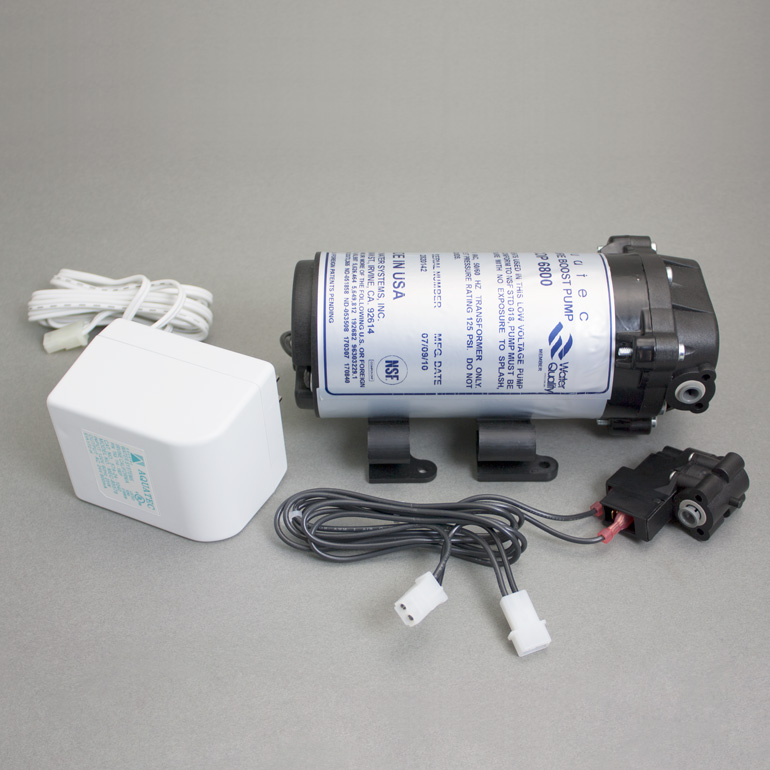
When you order the “pump package”, you get the transformer and the pressure switch as well.
For reverse osmosis units of 50 gallons-per-day or less production.
The 6800 pump will run your RO unit at an ideal pressure level regardless of the pressure going in. Pressure output is adjustable. It is very quiet and totally automatic. It shuts off automatically when the tank is full. Very easy to install. All fittings are John Guest quick connect.
This is a “continuous duty pump”, designed for many years of quiet, efficient service. You'll have to listen closely to know it's running, but you'll see a remarkable change in RO performance. The pressure switch installs in the tube that connects the tank to the unit. When ordering, please indicate on the order form if you wish a 1/4" (most common) or a 3/8" switch.
Must have 115 volt AC source. Electrical current usage is negligible.
Includes Aquatec 6800 pump, 115 volt transformer, and pressure switch (select your tube size from the drop-down menu during checkout.)
Aquatec 8800 RO Booster Pump
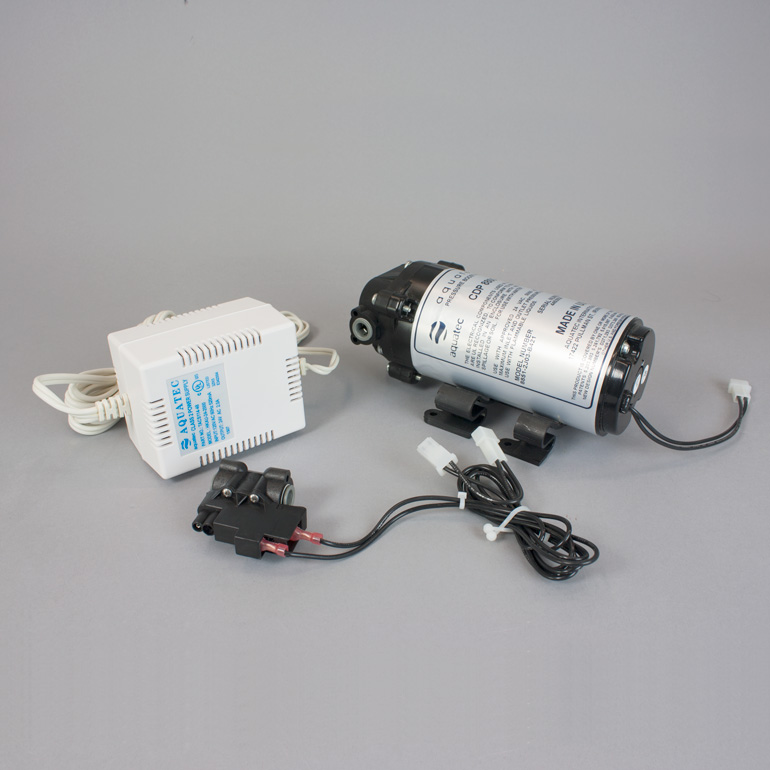
The 8800 is identical in appearance to the 6800 above, but is designed to provide added pressure for RO units that produce between 50 and 100 gallons per day.
The pressure switch installs in the tube that connects the tank to the unit. When ordering, please indicate on the order form if you wish a 1/4" (most common) or a 3/8" switch.
The pump must have a 115 volt AC source. Current usage is negligible.
It has 3/8" ports, so if you're going to use it with a 1/4" inlet line, ask us for adapters (no charge).
Includes Aquatec 8800 pump, 115 volt transformer, and pressure switch (select your tube size from the drop-down menu during checkout.)
Demand or Delivery Pumps
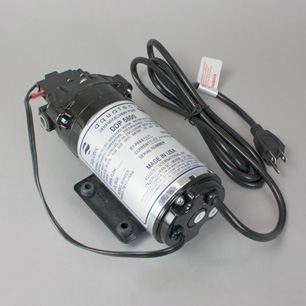
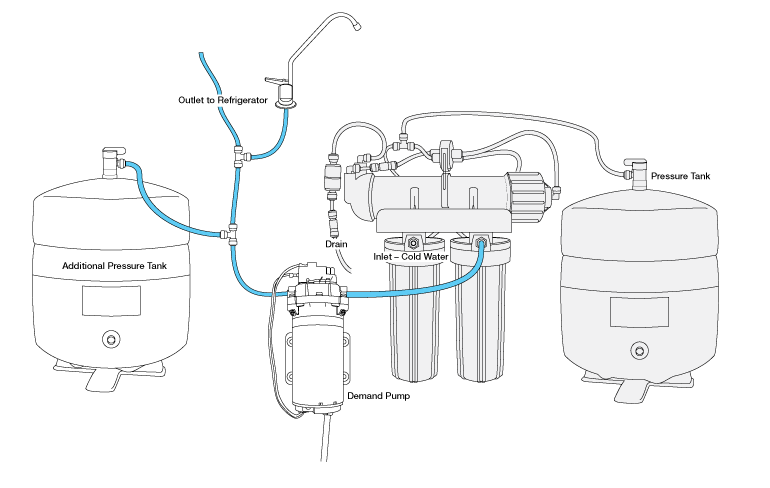
Demand pumps are sometimes installed with an RO storage tank, to prevent “chatter”. See diagram.
The RO Booster pumps above are especially designed for boosting the inlet water pressure to improve reverse osmosis performance.
A different type of pump called a Demand or Delivery Pump is needed to move water from a storage tank to an application — for example, to feed pressurized water to a refrigerator or a sink faucet. Pumps of this type are frequently used with distillers as well.
Demand pumps have a built-in pressure switch that turns them off when a certain pressure (60 or 70 psi, depending on the pump) is achieved. This means that they pump when there is a “demand” for water (e.g., when a faucet is opened) and turn off automatically when the demand is cancelled (e.g., when the faucet is turned off).
Although they work fine in most situations, you may have to install a small pressure tank, like an RO Storage Tank, in your delivery line to prevent “chatter” (intermittently turning itself off and on) by the pump. Normally this isn't necessary, but we thought we should warn you.
Both size demand pumps come standard with 3/8" quick connect ports, 1/4" reducing adapters can be included at no charge if requested during checkout.
Site Index
Filtration Systems
- Aeration for Iron & Sulfide
- Backwashing Filters
(whole house & well units)
- Chlorine & Chemical Injectors
- Countertop Water Filters
- Garden Hose Filters
- Reverse Osmosis, Residential
- Reverse Osmosis, Commercial
- Shower Filters
- Specialty Filters
- Ultraviolet Systems
- Undersink Filters
- Water Softeners
- Whole House Filters
Cartridges
Parts
- Replacement Parts
- Faucets
- Filter Media
- Fittings
- Housings
- O-rings
- Pumps
- Pura UV
- R.O. Parts
- R.O. Tanks
- R.O. Booster Pump
- VIQUA UV